
Medical disclaimer: This page is for information only. It does not constitute medical advice. If you think you have pompholyx or any other skin condition, please consult your GP or a dermatologist.
What is Pompholyx? (Also Known as Dyshidrotic Eczema)
If you’ve just found this site, there’s a reasonable chance you’re sitting somewhere staring at your hands wondering what on earth is happening to them. Tiny blisters. Intense itching. Possibly a burning sensation you weren’t expecting. And a visit to the GP that left you with a cream, a name you couldn’t quite pronounce, and not much else.
I know that feeling. I’ve had pompholyx for over 40 years. I set up the original version of this site back in 2008 because I couldn’t find anything online that felt like it was written by someone who actually understood what the condition is like to live with. That gap still exists, which is why I’ve rebuilt it.
This page explains what pompholyx actually is, what it feels like, who gets it, and how it’s diagnosed. It won’t replace a conversation with your doctor, but it will help you understand what you’re dealing with, which, in my experience, is half the battle.
What is pompholyx?
Pompholyx is a form of eczema that affects the hands and sometimes the feet. Its defining feature is the appearance of small, intensely itchy blisters, known medically as vesicles, that form deep within the skin, typically on the palms, the sides of the fingers, and the soles of the feet.
In the UK and outside the US, it’s known as pompholyx. In the United States, it’s more commonly called dyshidrotic eczema or dyshidrosis. You may also see it referred to as vesicular hand eczema, hand dermatitis, or cheiropompholyx (when it affects the hands) and pedopompholyx (when it affects the feet). They all refer to the same condition.
The word pompholyx comes from the Greek for bubble, which is an accurate description. Dyshidrotic, meaning “bad sweating” in Greek, is actually a misnomer. The condition isn’t directly caused by sweating, though sweating can play a role in triggering it.
What does pompholyx look like?
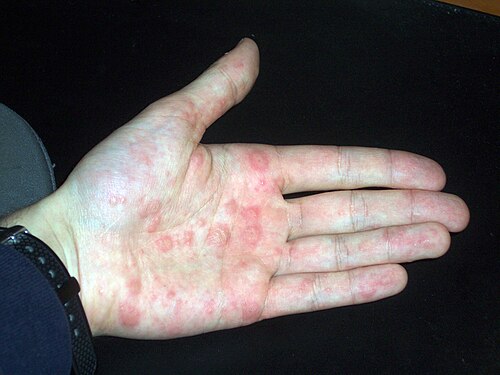
The blisters are small, often described as looking like tapioca pearls or frog spawn beneath the skin. They sit deep in the skin rather than on the surface, which gives them a distinctive appearance. In mild cases you might have just a handful of tiny bumps on one or two fingers. In more severe cases, the blisters can spread across the entire palm, join together into larger blisters, and extend to the feet as well.
My own experience has been at the milder end of the spectrum. I get clusters on my right hand and occasionally my left, on the sides of my fingers and on my palm near the base of my thumb. They’re unmistakeable once you know what you’re looking at.
As a flare progresses through its typical cycle, the blisters eventually dry up and the skin begins to peel, crack, and sometimes crust. This stage can be as uncomfortable as the blistering itself. Cracked skin on the hands is painful in a very practical, unavoidable way. Then the skin heals, until the next flare.
What does pompholyx feel like?
The dominant sensation is itching, often described as intense, maddening, deep itching that’s difficult to relieve. Some people also experience a burning sensation before the blisters appear, which can serve as a warning that a flare is coming.
In more severe cases the blisters can be painful rather than itchy, particularly if they’re large or if they form on weight-bearing areas of the feet. Secondary infection, when bacteria enter through broken or burst blisters, adds pain, redness, and swelling to the mix.
The psychological impact is real and often underestimated. I’ll be honest: I’ve always been very aware of the blisters when I have a flare, and for a long time they embarrassed me. Hands are visible in a way that most skin conditions aren’t. People notice. Pompholyx during a flare can be embarrassing, isolating, and genuinely depressing, particularly for those who have it severely or chronically. You’re not being oversensitive if you find it affects your mood and confidence. Many people do.
How common is pompholyx?
More common than most people realise. Pompholyx accounts for around 5 to 20% of all cases of hand eczema, and hand eczema as a whole affects roughly 10% of the population at some point in their lives. It’s most common in people between the ages of 20 and 40, and occurs slightly more often in women than in men.
If you’re sitting with itchy, blistered hands feeling like you’re the only person who has this, you’re not. There are millions of people managing the same condition, quietly and often without much support.
Is pompholyx the same as dyshidrotic eczema?
Yes. Pompholyx and dyshidrotic eczema are different names for the same condition. In the UK, pompholyx is the more commonly used clinical term. In the United States, dyshidrotic eczema is more familiar. Some dermatologists prefer the broader term acute and recurrent vesicular hand dermatitis, but you’re unlikely to encounter that outside of academic papers.
Throughout this site I use both terms interchangeably, so that people searching under either name find what they’re looking for.
Who gets pompholyx?
Pompholyx can affect people of any background or ethnicity. The condition tends to begin between the ages of 20 and 40, though it can appear at any age. It’s not something you can catch from another person. It’s not contagious in any way.
Certain factors appear to make someone more likely to develop it. A personal or family history of atopic conditions, such as eczema, asthma, or hay fever, increases the likelihood. Around 50% of people with pompholyx have an atopic background. A nickel allergy is also associated with the condition, affecting approximately 20% of sufferers. Interestingly, studies have found that around 75% of people with pompholyx are smokers, though the precise relationship between smoking and the condition isn’t fully understood.
Many people find that their pompholyx becomes less frequent and less severe as they get older. My own experience reflects this. My flares are significantly milder now than they were in my thirties. That’s not a universal rule, but it’s a common pattern and worth knowing if you’re newly diagnosed and wondering whether this is your life forever.
How is pompholyx diagnosed?
Diagnosis is usually straightforward for a GP or dermatologist who has seen the condition before. The appearance of the blisters, small, deep-seated, on the palms and sides of the fingers, is distinctive enough that a visual examination is often sufficient.
There’s no specific blood test or skin test that diagnoses pompholyx directly. However, your doctor may recommend patch testing to identify whether a contact allergen is triggering your flares. This involves applying small amounts of common allergens to the skin and monitoring reactions over 48 to 96 hours. It’s worth doing. Understanding your triggers is one of the most useful things you can know about your own condition.
In some cases, a skin biopsy may be taken to rule out other conditions, though this isn’t routinely necessary.
Is pompholyx hereditary?
Not in a straightforward sense. You can’t inherit pompholyx the way you might inherit eye colour. What you can inherit is a predisposition, an atopic tendency that makes you more susceptible to eczema conditions including pompholyx. If your parents have or had pompholyx, your chances of developing it may be slightly higher. But having the predisposition doesn’t mean you’ll necessarily develop the condition, and having pompholyx doesn’t mean your children will.
It’s also not something you pass on through contact. The fluid in the blisters is sterile. It can’t infect another person.
Still have a question? Ask it using the chat button on the right.
Frequently asked questions
What is the difference between pompholyx and dyshidrotic eczema?
They are the same condition. Pompholyx is the term more commonly used in the UK. Dyshidrotic eczema is used more often in the United States. Both describe a form of eczema characterised by itchy, deep-seated blisters on the hands and sometimes the feet.
Can you catch pompholyx from someone else?
No. Pompholyx is not contagious. The fluid inside the blisters is sterile and poses no infection risk to other people.
Is pompholyx permanent?
For many people it is a long-term, recurrent condition, meaning it comes and goes over months or years rather than resolving permanently after one episode. However, the severity and frequency of flares often reduces with age. Some people experience very long periods of remission.
Does pompholyx only affect the hands?
No. While the hands, particularly the palms and sides of the fingers, are most commonly affected, pompholyx can also affect the feet, particularly the soles and sides of the toes. Some people experience it on both hands and feet simultaneously.
Can children get pompholyx?
Yes, though it’s less common in children than in adults. It’s most frequently diagnosed in people aged 20 to 40.
Is pompholyx the same as a fungal infection?
No. Pompholyx is a form of eczema, not a fungal infection. However, a fungal infection of the feet (athlete’s foot) can sometimes trigger a pompholyx-like reaction on the hands, so it’s worth mentioning any foot symptoms to your doctor.
What next?
If you recognise what’s described on this page, the right first step is to see your GP or a dermatologist. They can confirm the diagnosis, identify possible triggers, and discuss treatment options with you.
This site covers all of those areas in detail. You might find these pages useful next:
Causes and Triggers, Treatments, Living with Pompholyx and Reader Stories.
The information on this page has been researched and written by Andy Brown, who has lived with pompholyx for over 40 years and has been running pompholyx information sites since 2008. It is intended for general information purposes only and does not constitute medical advice. This page has been reviewed for clinical accuracy by [Medical Reviewer Name, Qualifications]. Individual symptoms, causes, and appropriate treatments vary. Always consult a qualified GP or dermatologist for advice specific to your situation. If your skin condition is severe, worsening, or infected, seek medical attention promptly.