
Forty years with pompholyx: Andy’s story
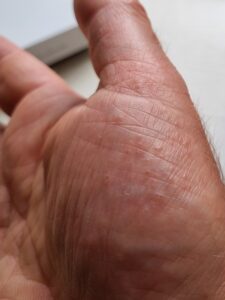
I’ve had pompholyx for around forty years. I first noticed something as a teenager but didn’t really understand what it was until my twenties. Back then there wasn’t much information available, and the name alone was enough to make it feel more alarming than it needed to be.
Mine shows up mainly on my right hand: along my forefinger, my thumb and on my palm at the base of my thumb. My left hand gets it too, particularly when I’m stressed or when I’ve been typing a lot and my hands have been resting on a desk.
I’m relatively lucky with the severity. It tends to stay as small blisters rather than the large, merging kind that some people describe. Persistent, but not the really bad flare-ups others experience.
What triggers it for me?
The clearest pattern is seasonal change. It gets worse when cold weather turns warm in spring, and again when summer tips into autumn. I sweat more in the heat, my hands feel more sensitive and that’s when things flare. The friction and warmth from typing seems to make it worse too. The areas that sit on the desk are consistently the worst affected.
Stress plays a role, though it took me a long time to see it clearly. It’s not that stress causes the pompholyx but when I’m run down or under pressure, my hands are more vulnerable.
What helps?
Moisturising has always been my main line of defence. I use Clinique for Men on my hands and find it works well. Switching to a raised keyboard helped too, because my palms no longer rest on the desk. A small change but a real one.
Swimming in the sea is something I’ve noticed makes a difference. The blisters seem to reduce afterwards. I’m not sure if it’s the cold temperature or the salt, but cold water alone doesn’t seem to have the same effect.
I’ve also used a frozen wine cooling sleeve to bring the hand temperature down when the itching gets bad. That helps more than you’d expect.
I’ll be honest: I’ve popped blisters in the past. The itching makes it hard to resist. But I’ve had secondary infections as a result, so I wouldn’t recommend it.
The social side
This is something people don’t always talk about but I think it matters.
At its worst, colleagues have asked what’s wrong with my hands. I’m pretty sure some people have avoided shaking hands with me. Reassuring people it isn’t contagious doesn’t always change how they react. That’s frustrating. So is the constant itchiness and the feeling of tautness in the skin during a flare. It’s not debilitating for me, but it is uncomfortable, and it does get under your skin in more ways than one.
The embarrassment I felt in my thirties about shaking hands during a flare-up was real. I don’t feel it as acutely now, partly because the flares are milder and partly because I’ve had forty years to make my peace with it.
Does it get better?
In my experience, yes, though I can’t fully explain why.
The flare-ups have become less severe as I’ve got older, particularly in my fifties. I’m not doing anything differently. But others I’ve spoken to say the same thing, and the research does suggest pompholyx tends to affect people most between the ages of twenty and forty. That’s some comfort if you’re in the thick of it right now.
That said, it doesn’t disappear. I’m writing this in late May after a hot week, and my right hand is already showing the early signs of a flare. It’s just part of life now. You learn to manage it rather than cure it.
That’s why I built this site.
About Andy
Andy Brown has had pompholyx for over 40 years. He built the original pompholyx.co.uk in 2008, one of the first dedicated patient information sites for the condition, and relaunched it as pompholyx.com in 2026. He lives in the UK.